


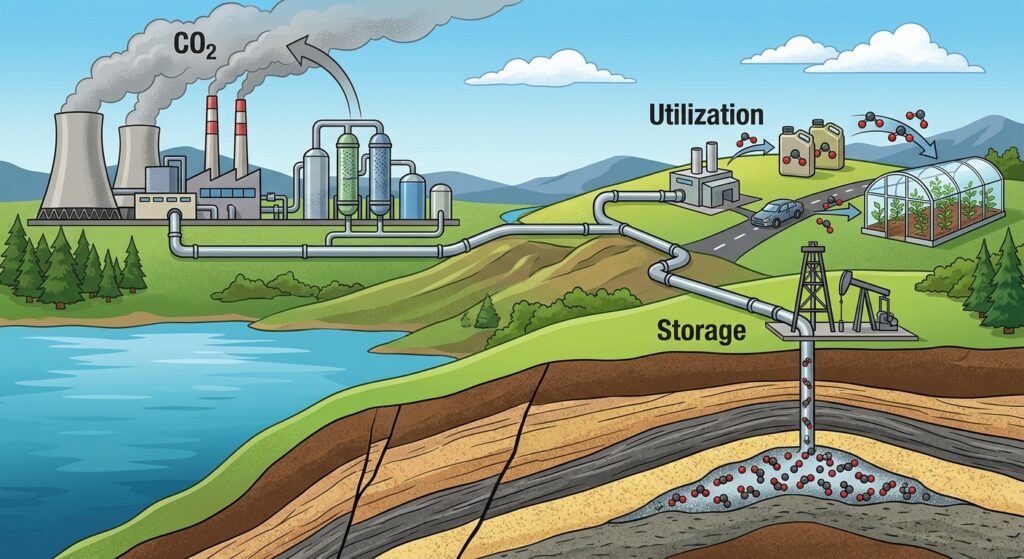
As industries around the world work to reduce carbon emissions, Carbon Capture, Utilization and Storage (CCUS) is becoming an increasingly important technology in the energy and industrial sectors.
But what exactly is CCUS, how does carbon capture work, and why is this technology relevant to the oil and gas industry?
This article explains the basics of CCUS technology, its main processes, applications, and its potential role in supporting lower-carbon industrial operations.
What Is CCUS?
CCUS stands for Carbon Capture, Utilization and Storage.
It is a technology pathway designed to capture carbon dioxide (CO₂) emissions from industrial processes or energy facilities before the CO₂ is released into the atmosphere.
The captured CO₂ can then be:
- Transported to another location
- Utilized in industrial processes
- Permanently stored underground
The overall concept can be summarized as:
Capture → Transport → Utilization or Storage
CCUS can therefore be applied as part of a broader strategy to manage industrial carbon emissions.
How Does CCUS Work?
The CCUS process generally consists of several key stages.
1. Carbon Capture
The first step is to separate and capture CO₂ from an emission source.
Carbon capture can be applied to emissions from facilities such as:
- Natural gas processing plants
- Refineries
- Power plants
- Cement plants
- Petrochemical facilities
- Hydrogen production facilities
- Other industrial processes
The captured CO₂ is then prepared for transportation.
2. CO₂ Transportation
After capture, CO₂ needs to be transported from the capture facility to its utilization or storage destination.
Depending on the project and location, transportation may involve pipelines, ships, or other transportation systems.
The transportation system needs to consider factors such as pressure, temperature, flow characteristics, safety, and infrastructure requirements.
3. Carbon Utilization
Captured CO₂ can potentially be used as a feedstock or input for certain industrial applications.
Examples may include:
- Chemical production
- Synthetic fuels
- Building materials
- Other industrial processes
The suitability of CO₂ utilization depends on the technology, economics, infrastructure, and characteristics of the specific project.
4. Carbon Storage
Instead of being utilized, captured CO₂ can be transported to a suitable geological storage site.
The CO₂ may then be injected into deep geological formations for long-term storage.
Potential storage formations can include suitable saline formations and depleted oil and gas reservoirs, subject to geological assessment and regulatory requirements.
What Is the Difference Between CCS and CCUS?
The terms CCS and CCUS are often used together, but there is a simple distinction.
CCS (Carbon Capture and Storage) focuses on capturing CO₂ and storing it.
CCUS (Carbon Capture, Utilization and Storage) includes both storage and the potential utilization of captured CO₂.
In other words, CCUS provides two potential pathways after carbon capture:
Capture → Storage
or
Capture → Utilization
The appropriate pathway depends on the project and the intended application.
Why Is CCUS Important for the Oil and Gas Industry?
The oil and gas industry has extensive experience with subsurface engineering, pipelines, wells, reservoirs, offshore operations, and large-scale energy infrastructure.
These capabilities can be relevant to the development of CCUS projects.
For example, knowledge and technologies related to:
- Reservoir characterization
- Well engineering
- Subsurface monitoring
- Pipeline systems
- Offshore facilities
- Injection operations
- Process engineering
- Asset integrity
can support different stages of CCUS project development.
This makes CCUS an important area of interest for professionals working across the energy sector.
CCUS and Offshore Carbon Storage
Offshore carbon storage is another area receiving attention as countries explore large-scale carbon management solutions.
For offshore projects, captured CO₂ may be transported to an offshore storage site and injected into suitable geological formations beneath the seabed.
However, developing offshore CCUS projects requires careful consideration of:
- Geological storage capacity
- Well integrity
- CO₂ transportation
- Injection systems
- Monitoring and verification
- Environmental considerations
- Regulatory requirements
- Operational safety
Because of these technical requirements, CCUS projects typically involve multidisciplinary teams from engineering, geology, operations, HSE, project management, and other technical fields.
What Are the Challenges of CCUS?
Although CCUS has significant potential, developing and operating CCUS projects involves several challenges.
These can include:
High Capital and Operating Costs
Carbon capture facilities and supporting infrastructure can require significant investment.
Transportation Infrastructure
Large-scale CCUS may require dedicated CO₂ transportation infrastructure, including pipelines or shipping systems.
Storage Site Selection
A suitable geological formation must be carefully evaluated to determine whether it can safely and effectively store CO₂ over the long term.
Monitoring and Verification
Projects require appropriate monitoring systems to evaluate the behavior of injected CO₂ and verify storage performance.
Regulatory and Environmental Requirements
CCUS projects must comply with applicable regulations and environmental requirements throughout their development and operation.
What Skills Are Needed in the CCUS Industry?
As CCUS projects develop, professionals from various technical backgrounds may become involved.
Relevant areas include:
- Process engineering
- Petroleum engineering
- Chemical engineering
- Mechanical engineering
- Subsea engineering
- Geology and geoscience
- Well engineering
- Pipeline engineering
- HSE
- Project management
- Operations and maintenance
For professionals in the oil and gas industry, understanding CCUS can therefore be a valuable addition to their knowledge as the energy sector continues to evolve.
The Future of CCUS
CCUS is increasingly being considered as part of the broader transition toward lower-carbon industrial operations.
Its application can be particularly relevant for industries where reducing emissions through electrification or other measures alone may be challenging.
The future development of CCUS will depend on factors such as technological development, project economics, infrastructure, regulation, storage resources, and the availability of skilled professionals.
For energy and industrial professionals, understanding carbon capture, utilization and storage can provide useful insight into how existing industry expertise may contribute to emerging carbon management technologies.
Conclusion
Carbon Capture, Utilization and Storage (CCUS) is an important technology pathway for managing CO₂ emissions from industrial and energy facilities.
From carbon capture and CO₂ transportation to utilization and geological storage, CCUS involves a wide range of technologies and professional disciplines.
For the oil and gas industry, CCUS also creates opportunities to apply existing expertise in subsurface engineering, wells, pipelines, offshore operations, and asset management to emerging carbon management projects.
As the energy industry continues to evolve, CCUS technology and carbon management are becoming increasingly relevant topics for companies and professionals preparing for the future of the energy sector.
FAQ About CCUS
What does CCUS stand for?
CCUS stands for Carbon Capture, Utilization and Storage.
What is CCUS technology?
CCUS is a technology pathway that captures CO₂ emissions and either utilizes the captured CO₂ or stores it in suitable geological formations.
What is the difference between CCS and CCUS?
CCS refers to Carbon Capture and Storage, while CCUS also includes the utilization of captured CO₂.
Why is CCUS important for oil and gas?
CCUS can leverage existing oil and gas expertise in areas such as subsurface engineering, wells, pipelines, offshore operations, and reservoir management.
Where can captured CO₂ be stored?
Captured CO₂ can potentially be stored in suitable deep geological formations, including saline formations and depleted oil and gas reservoirs, subject to technical and regulatory assessment.