

RIG TECHNOLOGY EVOLUTION: HOW OIL & GAS DRILLING HAS CHANGED
Rig technology evolution in the oil and gas industry has quietly transformed how we drill — and more importantly, how we protect the people doing it.
The oil and gas industry has never been easy. It was built on the backs of people willing to work at extreme heights, through deafening machine noise, under scorching sun and brutal weather. There were no systems to help them. No data streaming automatically. Only experience, instinct, and absolute trust in one’s own physical ability. But the rig technology evolution across the past few decades has changed this industry far more than most people realize — and the transformation isn’t just about smarter tools. It’s about a fundamental shift in how the industry values its people.
01 — How Driller’s Panel Technology Has Evolved
The rig technology evolution is perhaps most visible at the driller’s panel. In the past, a driller worked directly on the drill floor — standing in the open, exposed to constant noise, engine heat, and unpredictable weather. He read rig conditions through mechanical levers and analog gauges, relying on intuition built over years of field work. Data recording was done manually by the mud logger, with no automatic systems in place.
Then: Outside, directly on the drill floor. Mechanical levers and analog gauges. Rig conditions read intuitively from close range. Exposed to weather, noise, and engine heat. No automatic data recording — all done manually by the mud logger.
Now: Inside the doghouse, enclosed and comfortable. Digital touchscreen displays with real-time data. Operators monitor far more parameters simultaneously. Improved focus, reduced fatigue. WOB, RPM, torque, and hook load visible in real-time.
This shift is about much more than comfort. An operator who isn’t fatigued and isn’t subjected to constant noise will make better decisions at critical moments. The doghouse has become a true command center — not just a place to rest between connections.
02 — Mud Logging Technology: From Manual Sampling to Real-Time Sensors
Another key area of rig technology evolution is mud logging. Once, a geologist sat close to the wellbore, collecting mud samples one by one and analyzing them through a chromatograph. Interpretation depended entirely on the mudlogger’s expertise and experience. There was always a lag between sampling and results — and that lag could mean an undetected risk turning into a serious incident.
Then: Manual sampling and chromatograph analysis. Interpretation fully dependent on the mudlogger’s skills. Time gap between sample and result creates undetected risk windows.
Now: Digital real-time mud logging. Gas sensors monitor parameters continuously. Data streams directly to surface computers and cloud for early detection. LWD/MWD sends formation data from downhole. Kicks and influxes detected far sooner.
“Technology doesn’t replace the eyes of an experienced mudlogger — it gives those eyes the ability to see a thousand things at once.”
03 — Derrickman Safety: From the Monkeyboard to Automated Pipe Racking
The rig technology evolution has also dramatically changed one of the most dangerous roles on the rig. Few jobs are as physically demanding as the derrickman’s. He works at extreme heights, guiding every stand of pipe with his hands and his body. Bad weather is not a reason to stop. Courage, agility, and peak physical fitness are non-negotiable prerequisites — not admirable extras, but baseline requirements.
Now: Manual derrickman on the monkeyboard. Working at extreme heights to guide every pipe stand. Bad weather directly threatens safety. Heavily dependent on individual physical ability.
Future: Iron Derrickman / Automated Pipe Racker. Robotic arm racks pipe stands to the fingerboard automatically. The derrickman still supervises — from a far safer position. Fast, precise, and consistent racking. Height-related accidents minimized.
04 — Iron Roughneck: Replacing Heavy Manual Work on the Drill Floor
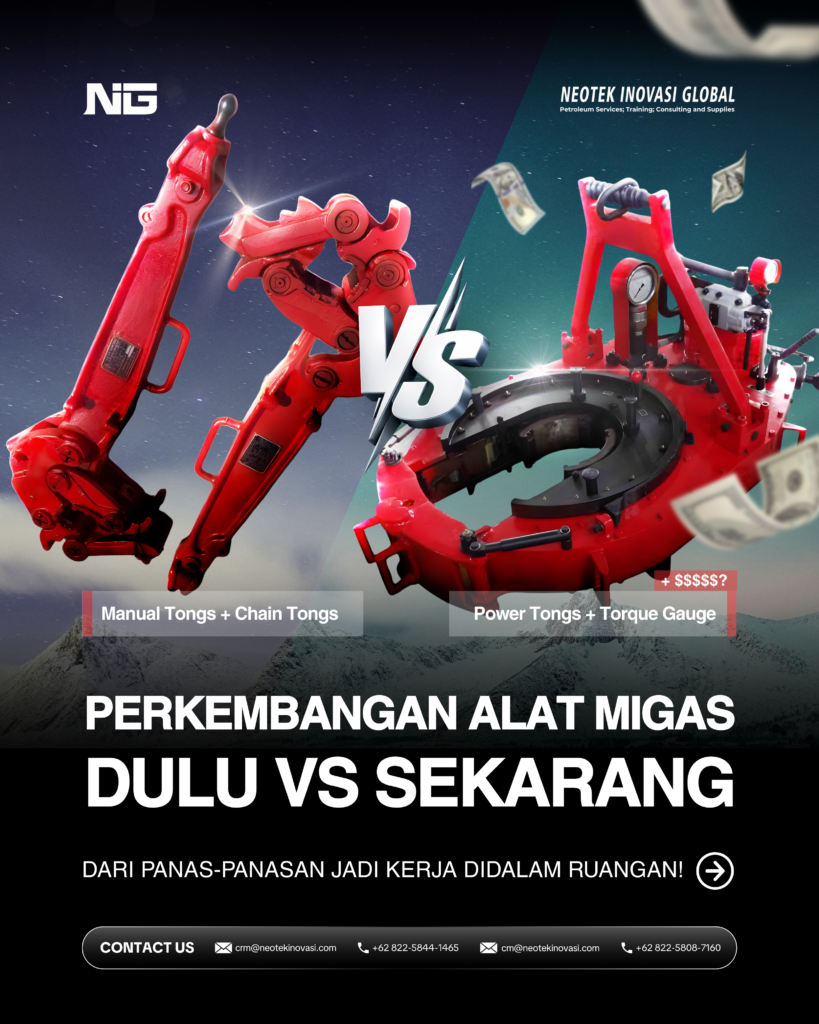
Perhaps the most visible symbol of rig technology evolution on the drill floor is the iron roughneck. In the past, three roughnecks would work together to break out pipe connections using heavy tongs. Team coordination, raw physical strength, and field experience were everything. The risk of injury wasn’t a theoretical concern — it was a daily reality inside one of the most hazardous zones on any rig.
Now: 3 manual roughnecks on the drill floor. Pipe breakout with heavy tongs requires coordination, strength, and high field experience. High risk of physical injury. Relies entirely on a solid, experienced crew.
Future: Iron Roughneck. High-precision robot replaces the heavy physical work. Spin-in and torque-up performed with no humans in the danger zone. Consistent torque per spec, minimal human error. Drill floor accidents dramatically reduced.
This rig technology evolution isn’t just about smarter machines. It’s about a fundamental shift in how the entire industry sees the human beings working within it. Where risk was once accepted as an inseparable part of the job, every accident is now viewed as a system failure — not fate. And that, above all else, is the most profound change ever to take place on a rig.